

We use Cookies!
Our website uses cookies. We use cookies to offer you a better browsing experience, analyze site traffic, personalize content, and serve targeted advertisements.
Learn more about how we use cookies and how to manage them by clicking "Cookie-settings".
ISO lifejacket inspection and servicing
Would you like to have your automatic or manually inflatable ISO lifejacket inspected? Nemad Maritime Safety provides inspection, servicing and advice on replacement through our service centres in Schiedam, the Netherlands, and Ostend, Belgium. Please provide the make and model so we can assess which servicing options are available for your lifejacket. You can drop off your lifejacket at a participating watersports shop or contact us beforehand to discuss inspection options.
A lifejacket may look sound on the outside while its inflation chamber, inflation mechanism or CO₂ cylinder needs attention. Use, moisture, UV exposure, storage conditions and material ageing all affect its condition. Periodic servicing checks more than just the exterior.
Which ISO lifejackets are covered by this service?
This page covers inflatable lifejackets in the ISO 12402 series, including 150N and 275N models. Both automatically and manually activated models have an inflation chamber, an inflation system and components that require inspection. Nemad Maritime Safety is a SOLAS service station recognised by the Dutch and Belgian shipping inspectorates, with service centres in Schiedam, the Netherlands, and Ostend, Belgium. Nemad Maritime Safety is certified by Mullion, Ocean Safety, Typhoon, KRU, Remploy, Spinlock, Seago, Lalizas, Baltic and Veleria San Giorgio, and is also certified to service Ocean Signal location beacons. Do you have an ISO lifejacket from another brand or a specialised model? You can also submit an inspection or servicing enquiry for these lifejackets. For each model, we assess the technical feasibility, available servicing information, suitable spare parts and applicable requirements.
A foam lifejacket or buoyancy aid requires a different inspection from an inflatable lifejacket. ISO 12402 specifies product requirements; ISO 18079-1 and ISO 18079-3 describe the organisation and procedures for servicing inflatable lifejackets. The manufacturer’s instructions for the specific model remain the determining requirements.
Models with a crotch strap
Does your lifejacket have a detachable crotch strap? Please include it with the lifejacket when submitting it for inspection.
Have you cut off the fixed crotch strap on your ISO lifejacket? Please be aware that your lifejacket no longer complies with the ISO 12402 product standard, and its specified and tested positioning in the water can no longer be guaranteed. This could put you at risk if you fall into the water. Your ISO lifejacket will fail the inspection.
If you prefer a detachable crotch strap, choose a lifejacket designed with one. Such a model has also been tested to ISO 12402 without the crotch strap. Our advice is to wear the crotch strap, especially in rough seas and when wearing clothing that provides buoyancy or traps air. You do not want your lifejacket to ride up in front of your face!
What is checked during a lifejacket inspection?
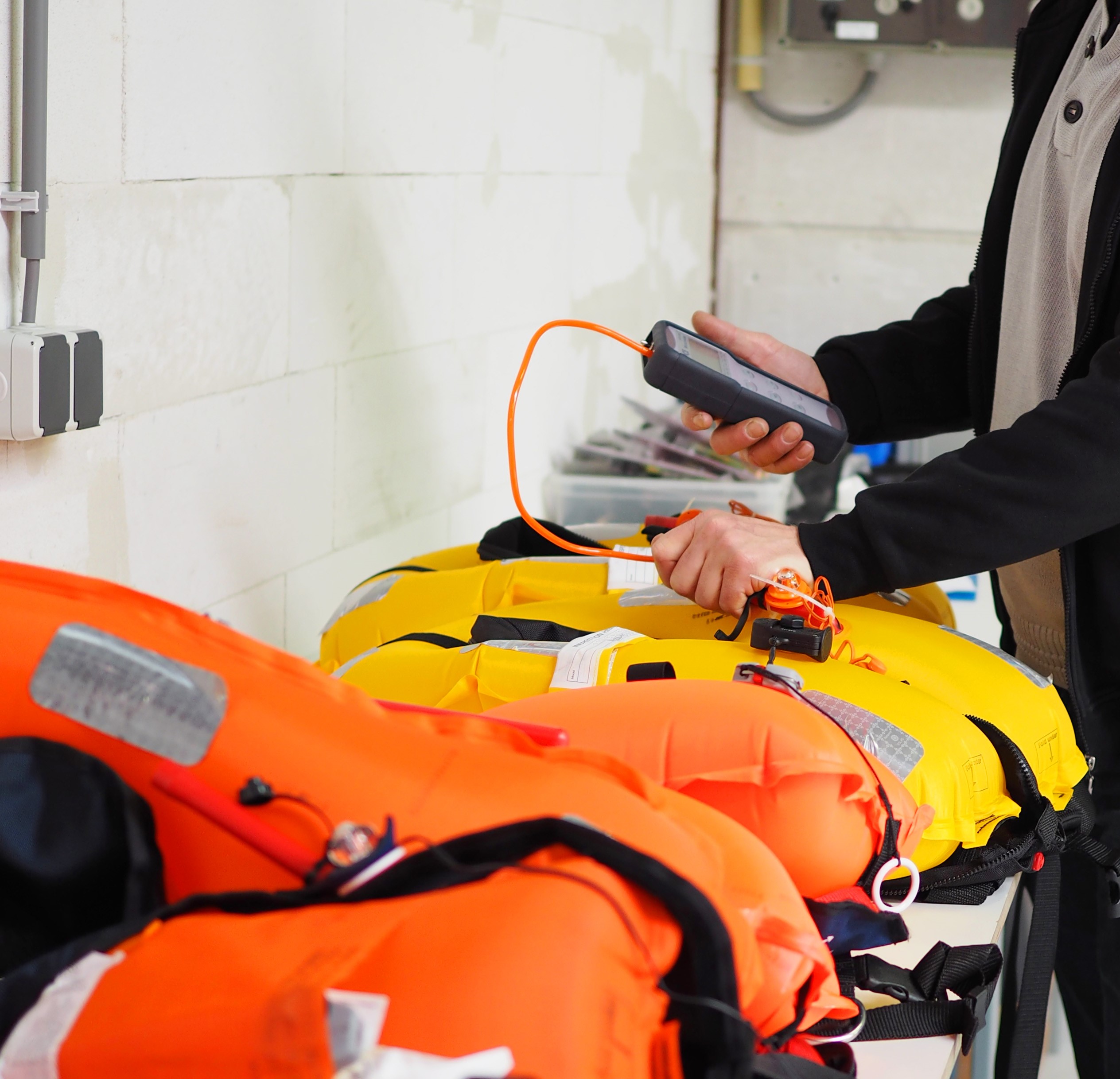
During professional servicing, the lifejacket and its components are examined in accordance with the applicable manufacturer’s instructions. The inspection includes:
- Cover, straps and fastenings: Checks for wear, damage, stitching, buckles and any crotch straps fitted.
- Inflation chamber and valves: Inspection for damage, followed by pressure and leak tests under the conditions specified by the manufacturer.
- Inflation mechanism: Checks of the mechanism fitted, its condition and any applicable component expiry dates.
- CO₂ cylinder: Checks of the correct cylinder type and charge, its weight, corrosion and overall condition.
- Safety accessories: Checks of the whistle, reflective material and, where fitted, the lifejacket light and location beacon, including their expiry dates.
- Service records and repacking: Recording findings and work carried out, marking service dates and repacking the dry lifejacket in accordance with the instructions for the model.
Components are replaced or repairs carried out where required by their condition and the manufacturer’s instructions. If the lifejacket cannot meet the servicing requirements and cannot be repaired, it will fail the inspection. The outcome and work carried out are recorded in the service documentation.
Lifejacket servicing for leisure boating: every year or every two years?
A two-year servicing interval is common for occasional leisure boating, but brands such as Mullion and Besto recommend annual servicing for their CE-approved lifejackets. A two-year interval is only appropriate where the instructions for the specific model permit it.
The Royal Netherlands Sea Rescue Institution (KNRM) recommends annual professional inspection on its lifejacket information page, supplemented by monthly checks by the user.
The expiry date of a cartridge or inflation mechanism does not replace the servicing interval for the complete lifejacket. Have the lifejacket assessed sooner after inflation, if there is damage or corrosion, or if you have any doubts about its operation. Do not wait until the next scheduled service.
Read the KNRM advice on lifejackets
Service life: when is replacement the better option?
In its service bulletin dated 12 April 2022, Mullion recommends replacing lifejackets no later than ten years after manufacture. Heavy use, unsuitable storage conditions or material ageing may make earlier replacement necessary. This is Mullion’s manufacturer guidance, rather than a universal maximum service life for all brands.
For Mullion lifejackets aged ten years or more, the bulletin still permits servicing where the customer has first been informed of the service life recommendation and nevertheless instructs the service station to proceed. The lifejacket must pass all servicing requirements. If it passes, the prescribed warning about its age and replacement must appear clearly on the service certificate. Passing the service does not override the replacement recommendation.
Dropping off your lifejacket at a watersports shop
Nemad works with watersports shops to arrange lifejacket inspections for leisure boaters. You can drop off your lifejacket at a participating shop. Following inspection, it will be returned through the agreed collection or delivery arrangement. A list of participating shops, including addresses and contact details, will be available shortly on the Dealer page.
Until then, contact Nemad Maritime Safety to find a suitable drop-off point. Bring the complete lifejacket and any previous inspection records you have. If additional work is required, you will receive a quotation through the watersports shop before that work is carried out.
Costs and turnaround times depend on the type and condition of the lifejacket, the parts required and transport arrangements through the shop. Do you have a planned departure date? Ask about the expected turnaround time in advance or agree a completion date.
Lifejacket inspection for commercial and professional use
Do you use ISO lifejackets for offshore work, port operations or other professional activities near water? Arrange inspection and servicing in accordance with the manufacturer’s instructions and the conditions of use. Heavy use may require more frequent checks.
Lifejackets used as personal protective equipment (PPE) fall under the European PPE Regulation (EU) 2016/425, as amended by Regulation (EU) 2024/2748, and are specifically designed to prevent drowning, even if the wearer becomes unconscious. They fall within Category III (high risk). For employers in the Netherlands and Belgium, suitable personal protective equipment, instruction and maintenance form part of occupational health and safety requirements. Periodic inspection based on the risk assessment is mandatory, and annual inspection is regarded as the minimum requirement.
Keep a record of each lifejacket’s identity, service date, work carried out and next service due date. When submitting an enquiry, explain how and where the lifejackets are used so that any applicable requirements can also be assessed.
How much does a lifejacket inspection cost?
Request a quotation for the inspection of your lifejackets. Please specify the make, model and quantity. Any cartridges, cylinders, lights or repairs required may affect the final cost.
For older lifejackets, it is also important to weigh up servicing against replacement. The manufacturer’s service life recommendation continues to apply, even where servicing remains technically possible.
Independent inspection: expertise and assessment of each model
For ISO lifejackets outside the SOLAS framework, we assess which inspection and servicing tasks can be carried out responsibly from a technical perspective. This requires expertise, suitable testing equipment, available procedures, appropriate parts and traceable records of the work performed.
Manufacturer approval, recognition by a competent authority and technical expertise are separate matters. When you submit an enquiry, we explain which services and service documentation are available for your make and model. Please also contact us if your brand is outside our manufacturer network.
Safe use between scheduled inspections
The KNRM emphasises wearing a suitable lifejacket and paying attention to its fit and crotch straps. Inspection helps assess its condition; wearing it correctly remains essential.
Use and check your lifejacket in accordance with its instructions. Between services, check straps and fastenings for damage and examine the condition of the inflation mechanism and cylinder. A visible indicator does not provide a complete picture of the lifejacket’s condition.
Frequently asked questions about lifejacket inspection and servicing
Should my lifejacket be inspected annually or every two years?
This depends on the manufacturer, model and use. Some leisure lifejackets have a two-year servicing interval; Mullion recommends annual servicing. Follow the instructions for your model. A component with an expiry date several years away does not mean the entire lifejacket can be used without servicing until that date.
Is inspection of an ISO lifejacket mandatory?
This depends on its use and the applicable requirements. An ISO product designation alone does not establish a general annual inspection requirement for every user. For professional use, applicable occupational safety and any maritime requirements must also be considered. Follow the manufacturer’s instructions; Mullion recommends annual servicing for its CE-approved lifejackets.
What is the difference between inspection and servicing?
When customers ask for an inspection, they usually mean a complete service. Inspection assesses condition and operation; servicing also includes the prescribed replacement of components, permitted repairs and correct repacking of the lifejacket.
Can I check my lifejacket myself?
Yes. The KNRM recommends monthly checks by the user. Follow the user manual when checking straps, fastenings, the inflation mechanism and cylinder. A green indicator does not replace a complete inspection or leak test. User checks supplement professional servicing.
Is replacing the CO₂ cylinder enough?
No. The inflation chamber, inflation mechanism, straps, buckles, valves and accessories must also be assessed. Only use the cylinder and components specified by the manufacturer for your model.
How long does a CO₂ cylinder last?
This depends on the manufacturer’s instructions and the condition of the cylinder. Servicing includes checks of its weight, charge and corrosion. There is no universal replacement interval that applies to all brands and models.
Does a lifejacket need to be inflated during inspection?
Yes. Servicing an inflatable lifejacket includes a pressure test of the inflation chamber. ISO 18079-3 specifies the use of dry compressed air at the pressure prescribed by the manufacturer. This does not automatically mean that the CO₂ cylinder is discharged during every service.
What should I do after my lifejacket has inflated?
Do not use the lifejacket again until it has been checked, rearmed where necessary and correctly repacked in accordance with the manufacturer’s instructions. When requesting a service, explain how the lifejacket was activated and whether it was used in the water.
Can a lifejacket aged ten years or more still be serviced?
For Mullion lifejackets, this is possible under the conditions set out in service bulletin 002 dated 12 April 2022. Mullion recommends replacement no later than ten years of age. Customers who request servicing after receiving this advice must allow for the possibility that the lifejacket will fail inspection or, if it passes, that a mandatory warning will appear on the certificate. Other brands have their own requirements.
Will I receive a service record?
The service outcome and work carried out are documented. For Mullion, a successful service is accompanied by a certificate of conformity; a lifejacket that fails inspection and cannot be repaired receives a rejection certificate. The service record does not constitute new product certification or override a service life recommendation.
Can 150N and 275N lifejackets be serviced?
Both types of inflatable lifejacket may require professional servicing. The correct components, test conditions and repacking method vary by model. Always provide the make and full model designation.
How much does lifejacket servicing cost?
The price depends on the make, model, quantity, required components and repairs. Request a quotation with the product details and any relevant additional information. A single fixed price for all lifejackets would not reflect these differences.
Where can I have my lifejacket serviced?
Contact Nemad Maritime Safety in Schiedam or Ostend. Please specify the make, model and number of lifejackets in advance so that servicing and delivery arrangements can be agreed.
Can I have an ISO lifejacket inspected outside the manufacturer’s service network?
For ISO lifejackets outside the SOLAS framework, you can submit a request to Nemad for independent inspection or servicing. We assess the options for each model and its conditions of use. Safety requirements, available manufacturer information, suitable components and applicable standards or contractual requirements remain relevant. Manufacturer approval and recognition by a shipping inspectorate are not interchangeable.
Can I drop off my lifejacket at a watersports shop for inspection?
Yes. You can drop off your lifejacket at a participating watersports shop. Following inspection, it will be returned through the agreed collection or delivery arrangement. Contact Nemad to find a suitable drop-off point while the Dealer page listing participating shops is still being developed. Bring any previous inspection records you have.
Please include the make, model, quantity, age and details of any damage or activation in your enquiry.